
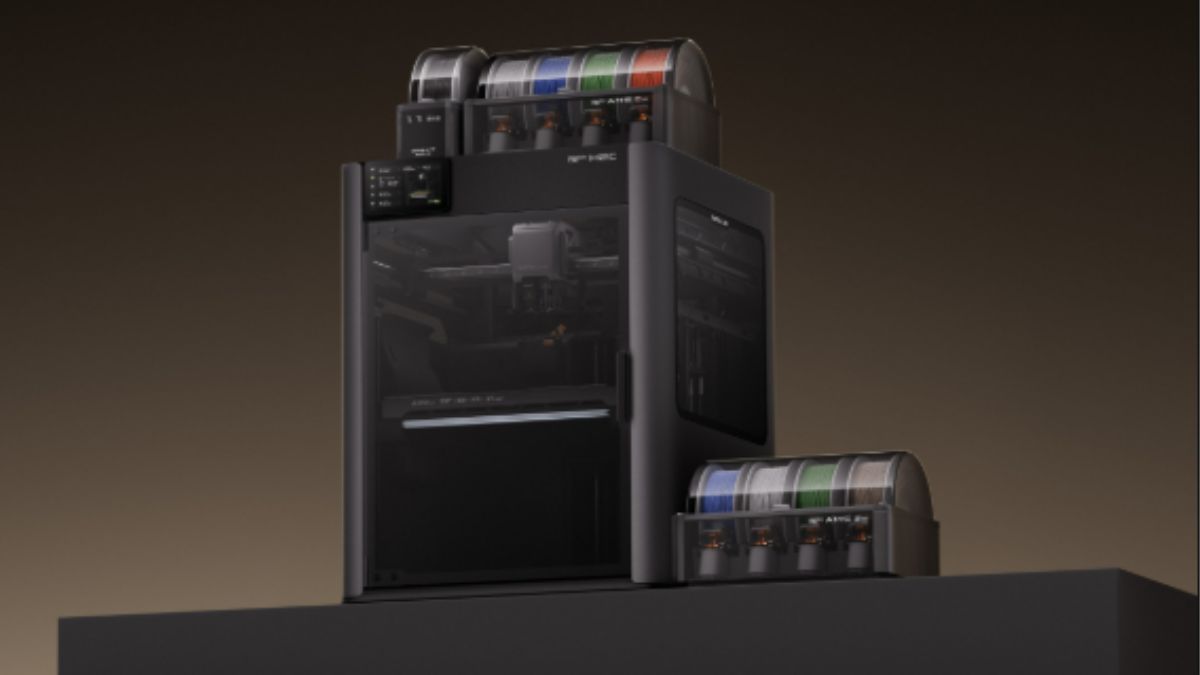
Managing separate machines for 3D printing, laser engraving, and cutting slows production and fragments workflow. The Bambu Lab H2 Series addresses that inefficiency by integrating four fabrication functions into one enclosed system.
Instead of switching hardware, users operate within a unified ecosystem. The result is tighter workflow control, improved precision alignment, and reduced physical footprint in labs, studios, and production spaces.
The H2 platform combines:
- CoreXY high-speed 3D printing
- Laser engraving and cutting
- Digital cutting
- Pen plotting
- AI-assisted monitoring and sensor systems
This consolidation is designed for advanced makers, engineers, and small production teams seeking multi-process capability without maintaining multiple devices.
Core Technical Foundation
The H2 Series is built around speed, temperature control, and motion accuracy. These fundamentals determine how well a hybrid system performs across different fabrication tasks.
Motion and Precision
The CoreXY motion system delivers high-speed printing while maintaining motion precision under 50 microns. Adaptive compensation continuously adjusts movement accuracy during operation.
This level of precision supports both rapid prototyping and detailed technical components that require dimensional consistency.
Thermal Performance
Engineering materials demand stable heat control. The H2 platform includes:
- Heated chamber maintaining approximately 65°C
- Hotend temperatures up to 350°C
This enables reliable printing with advanced polymers such as ABS, ASA, PC, PA, and reinforced carbon fiber or glass-filled materials.
Material Compatibility
The system supports:
- PLA
- PETG
- TPU
- ABS
- ASA
- PC
- PA
- Carbon fiber–reinforced materials
- Glass-filled composites
AMS compatibility allows automated multi-material handling, reducing manual filament swaps in complex projects.
Optical and Sensor Systems
Multiple cameras and sensors power AI-assisted monitoring. Select models include BirdsEye vision alignment for accurate multi-material positioning and oversight during print execution.
This reduces error rates and improves repeatability in professional workflows.
H2D: Dual-Extrusion for Complex Fabrication
The H2D is designed for users who prioritize multi-material and multi-color production.
Dual-Nozzle Architecture
The dual-nozzle configuration reduces purge waste compared to single-nozzle systems. Material transitions are faster and more efficient.
This improves workflow efficiency for:
- Multi-color prototypes
- Soluble support structures
- Functional dual-material parts
Build Volume and Capabilities
- Build volume: ~350 × 320 × 325 mm
- Nozzle temperature: up to 350°C
- Laser module options: 10W or 40W
The H2D integrates full laser functionality without requiring separate equipment. It suits users who want maximum versatility in a single machine.
H2S: Large-Format Simplicity
The H2S focuses on large-format printing with a single-nozzle architecture. This removes dual-extrusion complexity while preserving the broader H2 ecosystem.
Build and Environmental Control
- Build volume: 340 × 320 × 340 mm
- Motion precision: under 50 microns
- Active heated chamber: ~65°C
The consistent thermal environment stabilizes engineering materials across larger prints. Optional 10W laser and cutting modules expand capabilities without increasing footprint.
This model fits users prioritizing scale and simplicity over multi-nozzle workflows.
H2C: Tool-Changing Flexibility
The H2C introduces a modular tool-changing system for advanced fabrication control.
Vortek Hotend Change System
Automatic hotend swaps are powered by induction heating. This reduces downtime between nozzle configurations.
Users can maintain separate hotends for:
- High-flow printing
- Fine-detail work
- Specialized materials
Multi-Material Efficiency
The tool-changing architecture reduces filament waste during transitions. It enables structured multi-material workflows without dual-nozzle limitations.
- Build volume: 330 × 320 × 325 mm
- Optional laser and cutting modules
The H2C is aligned with advanced users who value modular expansion and workflow customization.
Laser and Cutting Integration
The H2 Series supports optional 10W and 40W laser modules, depending on configuration.
Laser engraving and cutting are executed within the same software and mechanical ecosystem as printing. There is no need to transfer workpieces between machines.
This improves:
- Alignment consistency
- Production speed
- Workspace efficiency
Digital cutting and plotting further expand fabrication versatility within the same enclosure.
Platform Advantages in Professional Use
The strength of the H2 Series lies in consolidation. By integrating four fabrication technologies, it reduces workflow fragmentation.
Key advantages include:
- High-temperature engineering material support
- AI-assisted reliability through multi-sensor monitoring
- Scalable modular ecosystem
- Reduced hardware footprint
- Centralized workflow control
For labs, product designers, and small production teams, this integration reduces operational overhead while expanding capability.
Implementation Considerations
The H2 Series is positioned as a premium system due to its integrated architecture and advanced hardware.
New users should anticipate a learning curve. Managing four fabrication technologies in one system requires deliberate workflow planning.
Treating the machine as a unified platform rather than four separate tools yields the strongest efficiency gains. Once workflows are optimized, the system delivers measurable improvements in speed, space usage, and production continuity.
The H2 Series is not designed as an entry-level device. It is engineered for users ready to leverage integrated fabrication at scale.